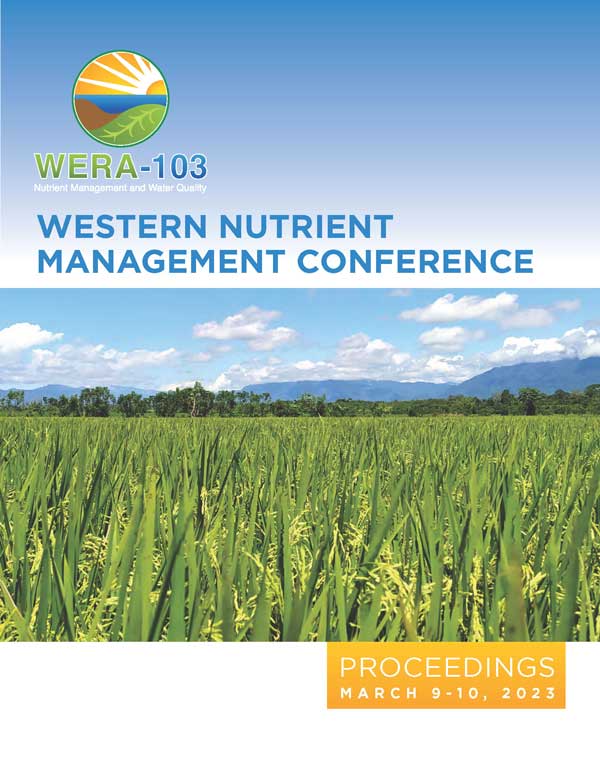
Download the Conference Proceedings
Proceedings
Authors
| Filter results12 paper(s) found. |
|---|
1. Compost Application in California Tomato Cropping SystemsWith the implementation of California Assembly Bill (AB) 341 the availability of composts such as green waste (GW) and co-composted green waste and food waste (FW) as a soil amendment is increasing. The use of those organic amendments in agricultural production systems has been recommended as an effective strategy to make full use of organic waste and improve soil health. However, little information is available to tomato growers to reassess N inputs from using GW and FW. This study was conducted... Q. Yi, W. Horwath, S. Haas, X. Zhu-barker |
2. Evaluating Cover Crops for Nitrogen Management in a Walnut OrchardCover crops provide numerous benefits in agricultural systems. From increasing soil water storage to reducing fertilizer inputs, quantifying cover crops benefits is crucial in nutrient management, crop productivity, environmental sustainability, and growers' adoption. The goal of this study was to quantify nitrogen (N) and carbon (C) inputs in a walnut (Juglans regia L. 'Chandler') orchard that implemented three cover crop mixtures. The study site was a 5-year-old walnut... D. Zapata, X. Zhu-barker, K. Steenwerth, W. Horwath |
3. Salt and Sediment Balances in an Irrigated Watershed in Southern IdahoThe quality of irrigation return flow in a 205,000 acre southern Idaho watershed has changed since 1970. Converting from furrow irrigation to sprinkler irrigation and installation of wetlands and sediment ponds have greatly reduced sediment loss. There is now more sediment in the irrigation water diverted into the watershed than returns to the Snake River (>100 lb a-1) compared to a net loss of 410 lb a-1 of sediment in 1971. There is also more soluble salt flowing into the watershed than... D. Bjorneberg, A. Koehn, J. Ippolito |
4. Sensor-based Technologies for Nitrogen Management in Spring WheatCrop sensor-based systems with developed algorithms for making mid-season fertilizer nitrogen (N) recommendations are commercially available to producers in some parts of the world. Although there is growing interest in these technologies by grain producers in Montana, use is limited by the lack of local research under Montana’s semiarid conditions. A field study was carried out at two locations in 2011, three locations in 2012, and two locations in 2013 in North West Montana. The objectives... O. Walsh, A. Pandey, R. Christiaens |
5. Evaluation of Micro-carbon Technology-based P Fertilizer, Super Phos®, in Spring WheatSuper Phos® (SP; 0-50-0) by Bio Huma Netics Inc. (Gilbert, AZ) is a Micro Carbon TechnologyTM – based phosphorus (P) fertilizer specifically formulated to resist “tie-up” with calcium (Ca) and magnesium (Mg) to remain water soluble and available to plant roots. The objective was to compare the efficiency and effectiveness of topdress and foliar application of SP, with traditional P fertilizers – ammonium polyphosphate (APP; 10-34-0), diammonium phosphate (DAP;... O. Walsh, A. Pandey, R. Christiaens |
6. Environmentally Smart Nitrogen Performance in Northern Great Plains’ Spring Wheat Production SystemsField trials were conducted at three locations in Montana to evaluate the efficacy of Environmentally Smart Nitrogen (ESN) (44-0-0) as a nitrogen (N) source for spring wheat. The ESN, urea (46-0-0), and a 50%-50% urea-ESN blend was applied at seeding at three rate levels - low, medium, and high - with actual rated dependent on the yield goal at each location, followed by urea application of 0 or 40 lb N/a at Feekes 5. Grain yield (GY) varied from 265 to 815 lb/a and grain protein (GP) content... O. Walsh, A. Pandey, R. Christiaens |
7. Liquid N Fertilizer Evaluation in Spring WheatSeveral liquid N products are currently marketed for fertilization in various crops, including spring wheat. Urea ammonium nitrate (UAN) - the most commonly used liquid N fertilizer - is associated with crop damage due to corrosiveness. This study aimed to answer the following questions: (1) Are liquid urea (LU) and High NRG-N (HNRGN) superior to UAN in improving spring wheat grain yield and protein content? And (2) what is the optimum dilution ratio of foliar fertilizers and the threshold at... O. Walsh, A. Pandey, R. Christiaens |
8. Creating Prescription Variable Rate Irrigation and Fertilization Zones: Water and Nutrient Management InteractionsVariable rate irrigation (VRI) and variable rate fertilization (VRF) technologies allow irrigation and fertilization rates to be spatially customized. VRF is widely adopted, but VRI is an emerging technology with minimal adoption. As water is often the driving force in nutrient cycling, our overall objectives are to evaluate VRI influences on VRF and vice versa; and to combine these technologies to significantly increase crop yield and quality, conserve water, and minimize environmental impacts... J. Svedin, N. Hansen, R. Kerry, R. Christensen, B. Hopkins |
9. Precision Sensing for Improved Wheat ProductionImproving nitrogen (N) use efficiency (NUE) from current 35-40% is important for growers’ sustainability and environmental quality. Unmanned Aerial Vehicles (UAVs) are proposed as an alternative to traditional field scouting for making crop management decisions. Precision sensors and cameras mounted on the UAVs provide high quality images which can be used to make fertilizer recommendations in-season based on crop nutrient status. A study was conducted at 5 locations in Southern Idaho in... O. Walsh, J. Marshall, J. Mcclintick-chess, S. Blanscet, C. Jackson |
10. Plant Available Silicon Application in Winter WheatMany studies throughout the world has shown that various crops have positively responded to silicon (Si) application in terms of plant health, nutrient uptake, yield, and quality. The study’ objective was to evaluate the effect of Si application rate and time on winter wheat growth and development, grain yield and grain quality. Results suggest that application of plant available silicon at 50% rate at either emergence or Feekes 5 appears to be more advantageous in terms of winter wheat... O. Walsh, J. Mcclintick-chess, S. Blanscet |
11. Response of Spring Wheat to Varied Nitrogen and Water ApplicationsThis study’s objectives were to 1) determine the minimum N and water requirements for optimum wheat grain yield and quality; 2) develop a sensor- based system for identifying – and distinguishing between – N and water stress; 3) produce grower recommendations based on the developed model; and 4) improve grower adoption of efficient water and N application practices and enhance grower understanding of sensor-based technologies. This was the first year of the study, project will... O. Walsh, J. Torrion, X. Liang, J. Mcclintick, S. Blanscet |
12. Nitrogen Fertilizer Rate and Timing Implications for Malt, Food, and Feed Barley Production in Southern IdahoNitrogen is an essential nutrient required to produce high-yielding barley. Nitrogen strongly impacts barley yield, grain protein, tillering, and lodging potential. Unlike other crops such as corn, available nitrogen must be carefully managed for producers to achieve both optimal yield and grain quality for malt, food, and feed barley. Exessive nitrogen availability increases grain protein concentration that may be unsuitable for malting but may be ideal for feed or food barley. The objective... J. Spackman, O. Walsh, A. Adjesiwor, O. Adeyemi, J. Sagers, R. Findlay, J. Bevan |