Download the Conference Proceedings
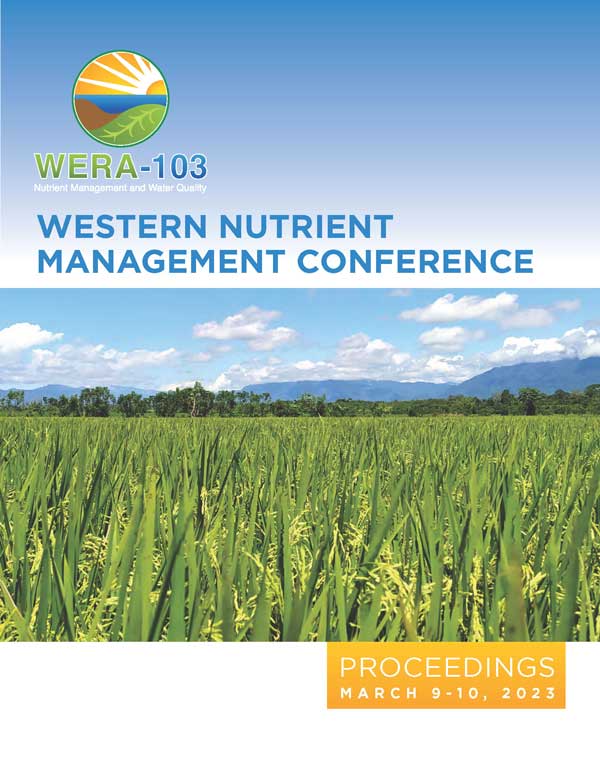
 
Get your copy of the 2023 Western Nutrient Management Conference Proceedings today! Download the PDF file and view all of the available proceedings.
WNMC Proceedings - March 2023.pdf

Proceedings

Find matching any: Reset
Koenig, R
Pattnaik, R
Clay, D
Add filter to result:
Authors
Koenig, R
Proctor, C
Johnston, W
Golob, C
Koenig, R
Yost, R
Pattnaik, R
Porter, G
Reese, C
Clay, D
Beck, D
Englund, R
Valencia-Gica, R
Yost, R
Porter, G
Pattnaik, R
Grossl, P
Koenig, R
Jones, C
Trolove, S
Topics
Type
Oral
Year
2007
2009
Home » Authors » Results

Authors

Filter results6 paper(s) found.

1. Urea and Ammonia Volatilization in Dryland Grass Seed Systems1

The purpose of this study was to evaluate the influence of grass seed production conditions and management practices on NH3 volatilization, Kentucky bluegrass seed yields and N recovery from urea. Laboratory incubations suggest the potential for NH3 volatilization is greater from stands in which post-harvest residue is baled and removed than from stands in which residue is burned. Both burned and unburned stands have a surface pH > 7.9, although pH declined with time in the burned... R. Koenig, C. Proctor, W. Johnston, C. Golob

2. Phosphorus Dynamics and Wheat Response to Applied P in a Spatially Variable Environment1

Considerable spatial and temporal variability exists in soil chemical and physical properties across farm landscapes in eastern Washington State. The purpose of this research is to investigate changes in P mineralogy across the Palouse landscape and ultimately to determine the influence of mineralogy on plant-available P and fertilizer P responses at different landscape positions. Soil samples were collected from landscape positions with varying soil pH and soil test P concentrations. Mineral... R. Koenig

3. Removing Nitrogen, Phosphate, and Fecal Coliform from Dairy Effluent Using Multi-soil-layer (Msl) Systems

Dairy effluent disposal has long been a concern in Hawaii. Dairies often establish multiple lagoons to accumulate and store effluent. Occasionally, the lagoons overflow leading to the transfer of nutrients, such as nitrogen (N) and phosphorus (P), and other contaminants such as pathogenic bacteria to surface, subsurface, and coastal waters. The objective of this study was to quantify the effectiveness of MSL systems in removing inorganic nitrogen, phosphate, and fecal indicator organisms (Fecal... R. Yost, R. Pattnaik, G. Porter

4. Is Protein Enough for Assessing Wheat Flour Quality?

The quality of wheat products such as bread, bagels, noodles or pizza that consumers purchase is based on the flour quality used in production. Flours with different characteristcs are needed to produce different products and flour quality is important to produce a quality end product. However, at the initial stage of flour production, wheat is sold on a grain protein premium basis by farmers to elevators and eventually millers. In many years, higher protein (> 15% protein) wheat can bring... C. Reese, D. Clay, D. Beck, R. Englund

5. Nutrient Cycling in Effluent-irrigated Soil (Mollisol) Planted to Tropical Grasses in a Tropical Island Environment

Dairy producers accumulate large quantities of effluent in lagoons. Lagoons occasionally overflow causing the nutrients and other contaminants in effluent to pollute the land and water bodies. Alternative uses of effluent are, therefore, urgently needed for a sustainable and environment-friendly dairy production. This study determined the sustainable effluent application rate and assessed the effects of effluent irrigation on plant and soil (Cumulic Haplustoll) properties. Five tropical grasses—... R. Valencia-gica, R. Yost, G. Porter, R. Pattnaik

6. Phosphorus Dynamics in Organic Matter-amended Soils

Generally, phosphorus (P) is considered immobile in calcareous soils. Yet, numerous studies have found that the addition of organic wastes (e.g. manures) can enhance P mobility in these soils. We believe that the soluble organic matter present in these wastes increases P solubility by inhibiting the sorption of inorganic P on soil colloidal surfaces and subsequently preventing the formation of insoluble calcium phosphates. This results in increased P bioavailability. Likewise, tests used to assess... P. Grossl, R. Koenig, C. Jones, S. Trolove