Download the Conference Proceedings
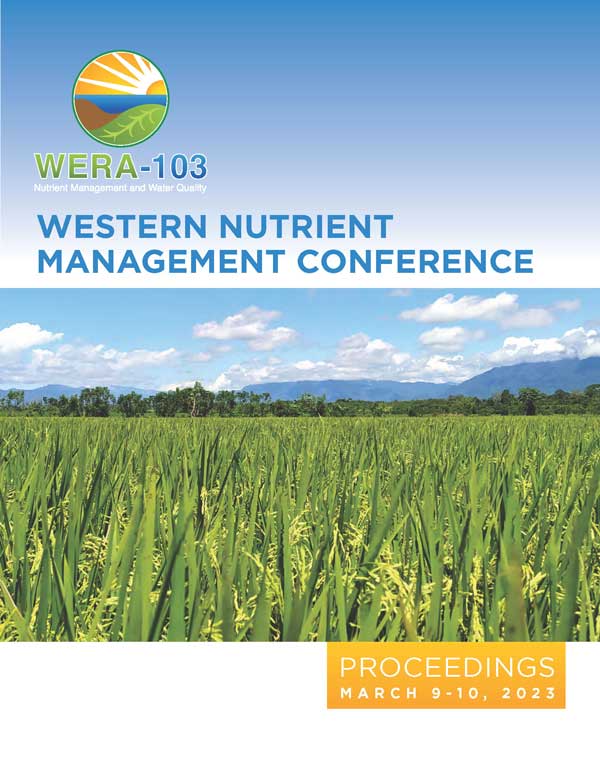
Proceedings
Authors
| Filter results11 paper(s) found. |
|---|
1. Is Mitigation of Drought Stress By Zinc Oxide Nanoparticles Driven By a Nano-Specific Mechanism or Alleviation of Micronutrient Deficiency?It has been reported that zinc oxide (ZnO) nanoparticles (NPs) can promote drought tolerance in crops when used as soil amendments. However, many of these experiments were conducted in Zn-deficient growth media with no comparison to currently available Zn fertilization methods, making it unclear if the benefits from adding ZnO NPs were caused by a nano-specifc mechanism or simply by the mitigation of a micronutrient deficiency. A review of the literature shows that of 12 published experiments... J.W. Deakin, M. Potter, A. Cartwright, J. Hortin, D. Sparks, J.E. Mclean, D.W. Britt, A.J. Anderson, A.R. Jacobson, L. Yen |
2. Assessing Nutrient Uptake and Accumulation in Oregon Hop ProductionCommercial hop production practices and cultivars have changed in the past 25 years and there is a need for updated nutrient management information under cotemporary practices. Current nutrient accumulation curves are only available for nitrogen (N). Current regional nutrient management guides from Oregon State University and Washington State University date back to the 1990’s or earlier. In the meantime, market forces and breeding efforts have led to a proliferation of new varieties, many... A. Moore, D. Gent, B. Verhoeven |
3. Static Range Nitrogen Management in Northwest U.S. Sugarbeet ProductionNitrogen (N) management is important in sugarbeet production. This paper presents data to support a shift from a yield-based N management approach to a static range N management approach in the Northwest U.S. Production data and research show that yield-based N management can result in over application of N. Past research has been critical to improving and understanding sugarbeet N nutrition. However continued research is needed so cumulative data can be evaluated to improve management practices.... D. Bjorneberg, D. Tarkalson, D. Olsen |
4. Is Residue Management an Important Factor in the Soil Health of Perennial Grass Seed Production Systems?Residue management in agricultural systems is a crucial pathway of nutrient and organic matter flow and is predicted to affect soil health indices. In Western Oregon, perennial grasses for seed are a major crop, occupying roughly 150,000 ha in the Willamette Valley. Current estimates are that 80-85% of producers remove straw residue, exporting more than 650,000 US tons of straw annually. The primary objectives of this study were: i) evaluate soil health outcomes under residue retention and removal... B. Verhoeven, A. Moore, D. Sullivan, M. Gonzalez-mateu |
5. Remote Sensing of Grape K Deficiency Symptoms Using Leaf Level Hyperspectral ReflectancePotassium (K) is an important nutrient for grape because it sustains charge neutrality during organic acid transport, is a major ion involved in osmoregulation and stomatal function and contributes to pH status in grapes and wines. We assessed the utility of a number of vegetation indexes for detection of K deficiency symptoms in a commercial vineyard of Vitis vinifera cv Pinot Noir. A hyperspectral field spectroradiometer for the 350-2500 nm spectral region was used to measure light reflectance... D. Smart, M. Whiting, C. Stockert |
6. Evaluation of N Uptake Analysis As a Tool for Determing Potato N StatusPlant tissue testing has become the primary method for evaluating nitrogen availability for potatoes during the growing season. This study was conducted to determine if plant N uptake rates referenced to absorbed solar radiation could also be used as a tool to quantitatively assess plant N status of different potato varieties. Nitrogen fertilizer, as NH4NO3 (34-0-0), was applied to Russet Burbank, Gem Russet, Bannock Russet and Summit Russet at three rates (0, 100, or 300 kg N/ha) using two... J. Stark, S. Love, C. Mcintosh |
7. Irrigated Small Grain Residue Management Effects on Soil Properties and Nutrient CyclingThe effects of straw removal from irrigated wheat and barley fields on soil properties and nutrient cycling is a concern due to its potential impact on the sustainability of agricultural production. The demand for animal bedding and the potential development of cellulosic ethanol production will likely increase straw demand in the future. Previous reviews addressing changes in soil properties when crop residues are removed focused primarily on rain-fed systems. This paper reviews published research... D. Tarkalson, B. Brown, D. Bjorneberg, H. Kok |
8. Seasonal Water Distribution in a Drip-irrigated Cabernet Sauvignon VineyardSeasonal irrigation is vital to sustainable production of wine grapes in inland Washington. Without supplemental irrigation there is not enough rainfall during summer months to sustain plant health and productivity. Our 5 year project evaluates the effects of several regulated deficit irrigation treatments on soil water distribution throughout the growing season and the subsequent effects on yield and fruit quality in both Cabernet Sauvignon (CS) and Concord grapes; with a focus on wine grape... J. Davenport, J. Stout |
9. Nitrogen Cycling and Fertilization in Legume Inclusive Cropping SystemsAmong other benefits, legumes contribute nitrogen (N) to subsequent crops. However, predicting the impact on yield and the timing of the N release is difficult. Regardless, adjustments in the N recommendation need to be made to avoid yield and crop quality problems, as well as negative environmental and social issues. Ideally, a reduction of pre-plant/early season N fertilizer is made based on field research. Two possible approaches are used, namely the Fertilizer Replacement Value (FRV) or the... B. Hopkins, J. Stark |
10. Approaches to Nutrient RecommendationsScientific based crop nitrogen (N) fertilizer recommendations are vital to guide N management within the agricultural sector. Accurate recommendations can maximize producer economic returns and minimize losses to the environment. Obtaining accurate recommendations is a dynamic process that requires constant research to update recommendations (within current scientific knowledge) and to better understand soil N cycle processes (develop new scientific knowledge) that can further improve... D. Tarkalson |
11. Sugar Beet Lime Characteristics and Effects on High pH Soils and Crops in the Western U.S.Each year in Idaho and Oregon, 351,000 Mg of precipitated calcium carbonate (PCC) (a byproduct of sucrose extraction from sugarbeet) is produced and stockpiled at sugarbeet processing factories. Currently there are limited disposal strategies for the PCC and these stockpiles continue to grow over time. The simplest solution would be to apply the PCC directly to agricultural fields each year, however the effects of PCC on high pH soils and crop rotations in the growing area are not well understood... D. Olsen, D. Bjorneberg, D. Tarkalson |